
Motorcycle tuning, what it does and whether it’s worth it
Motorcycle ECU tuning optimizes the factory software of a bike to improve power delivery, throttle response, and overall rideability. By recalibrating key engine parameters, professional remapping unlocks the true performance potential of a motorcycle while maintaining reliability and efficiency.
In this article
The pursuit of peak performance is not limited to four wheels. For many riders and professional workshops, the factory settings of a motorcycle are merely a starting point. Modern motorcycles are governed by complex Electronic Control Units (ECUs) that manage everything from fuel delivery to traction control. At Dyno-ChiptuningFiles, we specialize in unlocking the latent potential of these machines through precise software calibration, ensuring that the engine operates at its mechanical best.
What does tuning a motorcycle do?
At its core, tuning a motorcycle involves recalibrating the software maps within the ECU. Manufacturers often program these units with significant compromises to meet global emissions standards and varying fuel qualities. This frequently results in lean fueling conditions, "flat spots" in the powerband, and restricted throttle response.
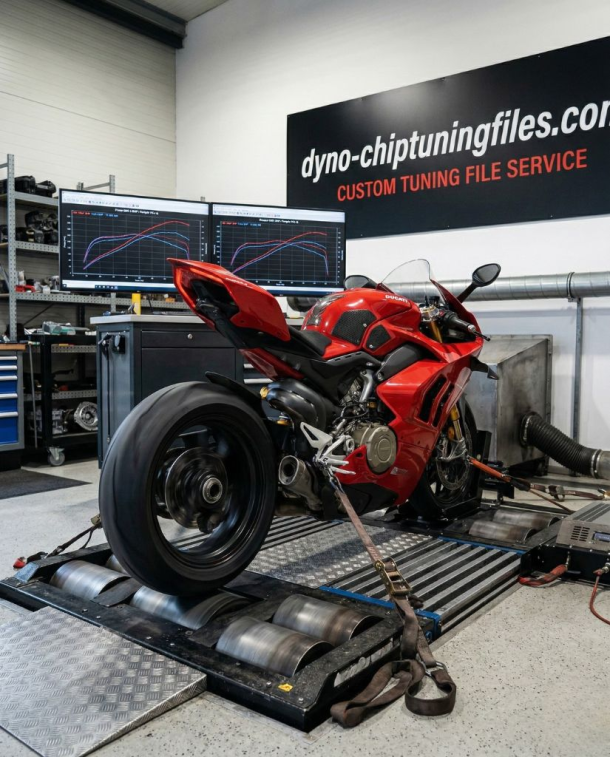
By remapping the ECU, we can adjust the air-fuel ratio (AFR), ignition timing, and throttle valve opening angles. This process harmonizes the engine components, especially when aftermarket exhausts or air filters are installed. The goal is to create a more linear and predictable power delivery that enhances the connection between the rider's wrist and the rear tire.
Determining if your motorcycle needs a tune
Many riders ask how they can identify if their motorcycle needs a tune. There are several technical indicators that suggest the factory software is no longer adequate for the machine's current configuration or usage:
-
Surging or hesitation: If the bike feels "jerky" at constant speeds or low throttle openings, it is often a sign of a lean fuel mixture.
-
Excessive heat: Engines running too lean tend to operate at higher temperatures, which can lead to premature component wear.
-
Popping on deceleration: This is frequently caused by unburnt fuel igniting in the exhaust due to improper mapping after a hardware change.
-
Lack of throttle precision: A delayed or aggressive response when rolling on the throttle often indicates that the electronic throttle valves are restricted by factory limiters.
If a motorcycle exhibits these traits, professional recalibration is not just an upgrade; it is a necessity for the health and rideability of the engine.