
Tuning files and ECU formats
This page explains what tuning files and ECU file formats are and how professionals use them in practice. It covers how ECU files are read, interpreted, and turned into safe, validated tuning files for reliable results.
In this article
Tuning files and ECU formats what they are and how to use them
Professional tuners workshops and experienced enthusiasts work daily with ECU files but the terminology around tuning files and formats is often unclear. Terms such as tuning file ECU file format or ECU map file are used interchangeably while they describe different aspects of the same process. A clear understanding is essential if you want predictable safe results and an efficient workflow.
We develop and supplly professional calibrations every day. Our engineers work in structured ECU projects supported by extensive dyno validation. From that perspective we can explain exactly what tuning files are how you read and open ECU files and how different formats fit into a professional process.
What tuning files are in a professional context
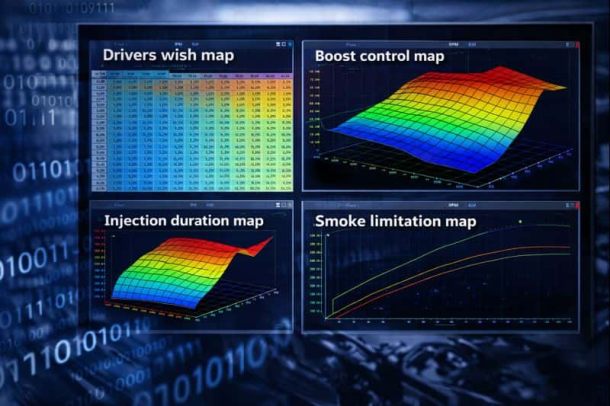
A tuning file is the modified calibration file for an engine or transmission control unit. It is the software variant you write back into the ECU after the original file has been read edited and validated.
In practical terms a tuning file contains adjusted versions of for example:
-
Torque request and torque limitation maps
-
Boost pressure targets and control maps
-
Fuel quantity duration and rail pressure tables
-
Lambda or smoke limitation structures
-
Protection strategies for exhaust gas temperature turbocharger and gearbox
-
Speed limiters and specific drivability functions
If you ask what is a tuning file or what are tuning files the answer is that they are the calibrated versions of the ECU software tailored for specific goals such as performance efficiency or dedicated hardware setups.
For a workshop or professional tuner it is important that each tuning file:
-
Is based on the correct original software version
-
Maintains a coherent torque and load structure
-
Respects safe margins for the mechanical components
-
Can be traced back to vehicle and software identification
This is the level of structure that we apply in every project.
ECU file formats and map data structure
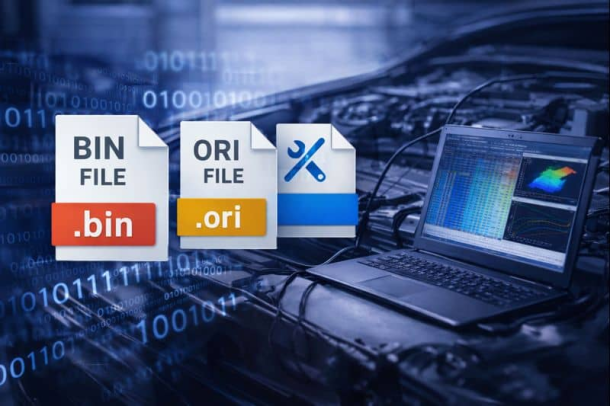
When you read an ECU you obtain a binary file that contains one or more segments of code and calibration data. The term ECU file format refers to the way this data is stored and handled by tools and software.
Common file extensions include:
-
bin which indicates a raw binary file
-
ori often used in the tuning world to label original files
-
Tool specific extensions created by particular flashing tools
The extension itself is only a label. What matters is how the data inside is arranged. Program code and calibration maps may be stored in different regions and in some cases an additional EEPROM section is present for immobilizer or adaptation data.
When people ask what is the ECU file format or what format is the ECU map file they are usually referring to how the calibration area is contained within this binary and how it is presented in calibration software.
How ECU files are read in the workshop
How do you read an ECU file in a professional environment This step is critical because any missing or corrupted data will compromise later tuning work.
In most workshops an ECU file is read by:
-
Diagnostic connection reading via the OBD socket when possible
-
Bench connection on the ECU connector with dedicated breakout cables
-
Direct connection on the circuit board in specific cases where other options are blocked
The flashing tool communicates with the ECU bootloader and retrieves the required memory content. The result is a binary file stored on your computer.
We always recommend:
-
Using approved professional tools with clear protocols
-
Saving complete reads including all segments whenever the tool allows this
-
Keeping an untouched backup of the first read file for safety and traceability
With a clean read in place the file can be analysed and converted into a tuning file.
Opening and working with tuning files
The next common question is how do I open tuning files. It is important to distinguish between opening a file simply to write it to a vehicle and opening a file to edit maps.
For flashing only:
-
You use your flashing tool software
-
You select the tuning file supplied by Dyno-ChiptuningFiles.com
-
You follow the write procedure as instructed by the tool and the vehicle specific guidelines
For calibration work and map editing:
-
You use dedicated calibration software that can interpret the binary structure
-
Map packs or definitions are applied to locate important maps
-
Changes are made in a controlled way with full visibility of axes units and interpolations
Opening a tuning file in a normal text editor is useless and risky. You will only see unreadable characters and there is a real chance of damaging the file if it is accidentally modified or saved in a different format.
Dyno-ChiptuningFiles performs all calibration work inside professional development environments. Workshops that only need to program vehicles do not have to open or edit the content they simply use the validated file provided.
ECU map file formats in calibration software
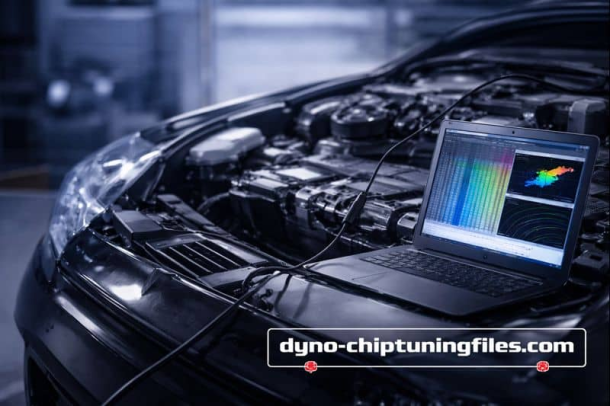
Inside calibration software the raw ECU file is interpreted as a project with a collection of maps. These maps are not separate files on disk but logical structures inside the same binary.
Typical map types include
-
Drivers wish or accelerator request maps
-
Torque monitoring and limitation maps
-
Boost pressure control and air mass management
-
Fuel maps including start of injection and duration
-
Lambda targets and smoke or soot limitation
-
Various temperature and component protection maps
The question what format is the ECU map file is therefore best answered as follows there is usually one binary ECU file and within that file the calibration software defines map objects with axes units and descriptions. The way these are presented depends on the software but the underlying data remains the same.
Dyno maintains extensive definition sets and internal documentation for many control units. This allows our programmers to adjust exactly the right maps in a way that keeps the entire torque structure consistent and predictable.
How we support professional users
For professional tuners and workshops the choice of file service has a direct impact on risk and efficiency. By combining structured ECU file formats with tested tuning files we offer concrete advantages:
-
Experienced and certified calibrators who work daily with complex control units
-
Dyno validated calibrations with real vehicle logging and monitoring
-
Careful management of original and tuned files for traceability
-
Technical documentation and clear naming so you always know what you are programming
-
Support that speaks the same technical language as your workshop team
Because our workflow is built around controlled reading editing and validation of ECU files you can focus on your core tasks customer contact mechanical work and efficient programming while relying on consistent file quality.
Tuning files are the calibrated versions of ECU software that determine how an engine or transmission behaves. Understanding what a tuning file is how to read an ECU file and how different ECU formats relate to map data is essential for any professional tuner or workshop.
In practice you read the ECU with a suitable tool obtain a binary file and let a specialist such as Dyno-ChiptuningFiles create a safe well structured tuning file. You then program this file back into the vehicle using your flashing equipment with full confidence that the calibration has been developed and validated in a professional environment.
This combination of correct ECU file handling and expert calibration work is what delivers reliable repeatable results for your customers day after day.