
Types of ECU Tuning Tools Explained
This guide explains how ECU tuning tools work, the different access methods (OBD, Bench, Boot), and the difference between master and slave tools. It does not recommend specific products.
In this article
Types of ECU Tuning Tools Explained
ECU tuning tools are often misunderstood.
Many people assume a tuning tool creates tuning files or improves engine performance by itself.
That assumption is incorrect.
An ECU tuning tool is a communication and access device.
Its role is limited, but essential: it allows you to read data from an ECU and write modified data back.
Understanding the different types of ECU tuning tools is crucial before choosing a setup.
What an ECU Tuning Tool Actually Does
All ECU tuning tools perform the same core function:
-
Reading the original ECU software
-
Writing a modified ECU file back to the vehicle
-
Communicating with the ECU via specific protocols
What a tuning tool does not do:
-
It does not create tuning strategies
-
It does not calculate safe performance values
-
It does not validate tuning quality
-
It does not prevent tuning mistakes
The quality of a tuning result depends on what is written, not on the tool used to write it.
The Three Main ECU Access Methods
The most important distinction between tuning tools is how they access the ECU.
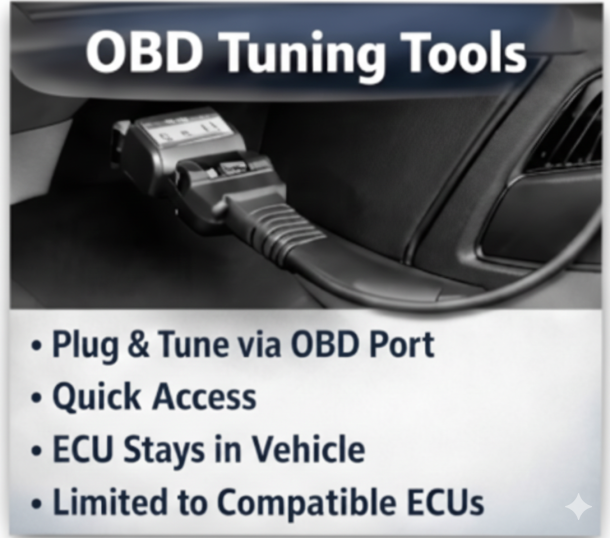
OBD Tuning Tools
OBD tools communicate with the ECU through the vehicle’s diagnostic port.
Used when:
-
The ECU allows OBD access
-
No security restrictions block communication
-
Fast, non-invasive access is preferred
Characteristics:
-
ECU remains installed in the vehicle
-
Fast read/write process
-
Limited recovery options
Limitations:
-
Not all ECUs support OBD access
-
Some modern ECUs are locked
-
Higher risk if communication is interrupted
OBD access is convenient, but not universal. Read more about OBD2 Tuning.
Bench Tuning Tools
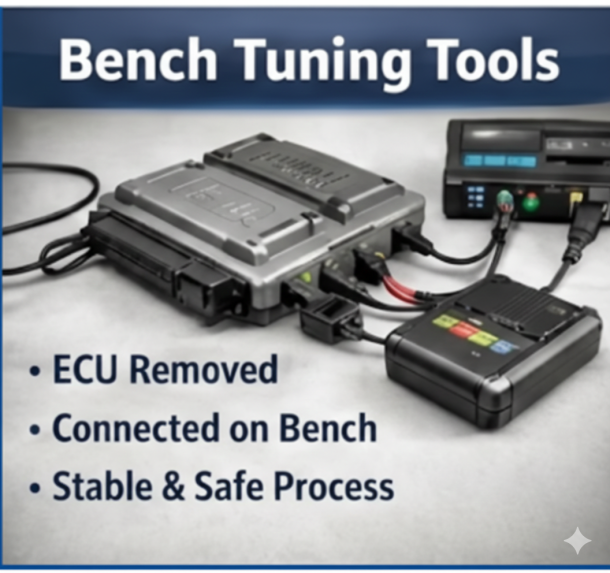
Bench tuning requires removing the ECU and connecting it externally.
Used when:
-
OBD access is restricted
-
More stable communication is required
-
Broader ECU coverage is needed
Characteristics:
-
ECU is physically removed
-
External power supply and connectors are used
-
Safer read/write process than OBD in many cases
Limitations:
-
More time per job
-
ECU removal is required
-
Not always practical in daily workflows
Bench tuning access is often the next step when OBD tuning is not possible.
Boot Mode Tuning Tools
Boot mode tools access the ECU at its lowest communication level.
Used when:
-
ECUs are encrypted or locked
-
Full access is required
-
ECU recovery is needed
Characteristics:
-
Direct access to ECU memory
-
Highest compatibility with modern ECUs
-
Essential for many newer vehicles
Limitations:
-
Highest technical complexity
-
Incorrect procedures can damage the ECU
-
Requires experience and correct tooling
Boot tuning mode is not “advanced tuning” — it is advanced ECU access.
Master vs Slave Tools Explained
Another key distinction is the tool license model.
Slave Tools
Slave tools encrypt ECU files and link them to a specific provider.
Typical use:
-
Workshops using professional file services
-
Starters who do not modify files themselves
Advantages:
-
Lower risk
-
Simplified workflow
-
Reduced chance of file errors
Limitations:
-
Files cannot be edited independently
-
Dependence on the provider ecosystem
Slave tools are common in professional environments where file creation is outsourced.
Master Tools
Master tools provide access to unencrypted ECU files.
Typical use:
-
Tuners editing files themselves
-
Advanced workflows using tuning software
Advantages:
-
Full file control
-
Compatibility with professional editing software
-
Maximum flexibility
Limitations:
-
Higher responsibility
-
Requires deep technical knowledge
-
Errors must be solved by the user
A master tool does not make someone a tuner.
It only removes restrictions.
Tools vs Tuning Software
A chiptuning tuning tool handles communication.
Tuning software like WinOLS handles file modification.
These are separate roles.
Most professional workflows combine:
-
A tuning tool for reading and writing
-
Tuning software or a file service for modification
-
Validation and support processes
Confusing these roles is one of the most common beginner mistakes.
Professional ECU Tuning Tool Ecosystems
In professional environments, tuning tools are selected based on:
-
ECU coverage
-
Stability and update frequency
-
Compatibility with file services and software
-
Long-term support
Our professional platform include solutions from Alientech, Autotuner, CMD Flash and Magic Motorsport.
The tool itself is only one part of a complete tuning setup.
What ECU Tuning Tools Do Not Do
This is critical to understand.
ECU tuning tools do not:
-
Generate tuning files
-
Understand engine limits
-
Guarantee safe results
-
Replace tuning knowledge or experience
They provide access.
Everything else depends on the workflow around them.
When a Tuning Tool Becomes Effective
A tuning tool becomes effective only when combined with:
-
Reliable tuning files or software
-
ECU knowledge
-
Proper validation
-
Ongoing technical support
Without that structure, even the most advanced tool is just a communication device.
Next Step
Understanding how ECU tuning tools work should come before choosing one.
Once you understand:
-
Access methods
-
License models
-
Workflow requirements
Selecting the right tool becomes a logical decision - not a risk.