
Does ECU Remapping Improve HP and MPG? | Technical Guide
Discover how ECU remapping affects horsepower and fuel economy. Dyno-ChiptuningFiles explains the technical reality of tuning petrol and diesel engines.
In this article
In the world of automotive optimization, there is often a debate about whether a software modification can truly deliver on the dual promise of increased power and better efficiency. For workshops and professional tuners, providing an evidence based answer is key to maintaining credibility. At Dyno-ChiptuningFiles, we utilize rigorous testing to prove that a high quality calibration does more than just tweak a few settings; it fundamentally optimizes the engine’s operational logic.
Does ECU remapping really work?
To understand if remapping works, one must understand why manufacturers leave room for improvement. Vehicles are built for a global market, meaning they must operate in extreme climates, handle poor fuel quality, and meet varying tax brackets. Consequently, the factory software is often a detuned compromise.
A professional remap works by accessing the maps within the Engine Control Unit and adjusting parameters such as ignition timing, boost pressure, and fuel delivery. When these are aligned with local fuel quality and specific mechanical tolerances, the results are immediate. Through our dyno tested files, we consistently see improvements in throttle response, torque delivery, and top end power, proving that the latent potential of the engine was simply waiting to be unlocked.
Power gains and the petrol question
One of the most frequent questions from clients is: how much HP does a remap add? There is no universal number, as the gains depend heavily on the aspiration of the engine and the hardware involved.
Expected horsepower increases
Turbocharged engines, both diesel and petrol, see the most significant gains. A professional Stage 1 remap typically adds between 20% and 35% more horsepower. This is achieved primarily by optimizing the turbocharger's boost curve and the associated fueling.
Naturally aspirated engines see more modest gains, usually between 5% and 10%. Here, the focus is on sharpening throttle response and optimizing ignition timing for higher octane fuel.
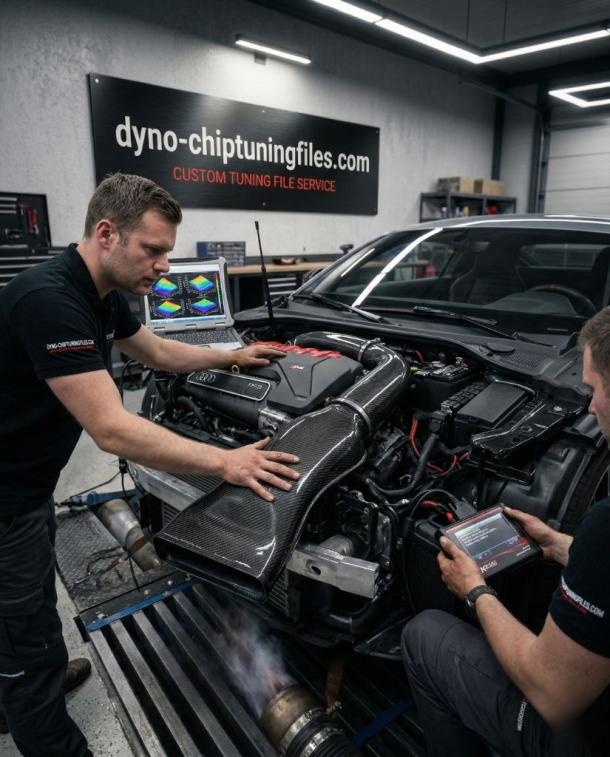
Can petrol be remapped?
There is a common misconception that remapping is primarily for diesel engines. In reality, petrol engines can be remapped with exceptional results, especially modern turbocharged units such as TSI, TCE, or Ecoboost engines. Even without a turbocharger, adjusting the air fuel ratio and removing factory limiters can enhance the driving experience of a petrol vehicle. Naturally aspirated engines can also often benefit from software updates derived from higher output variants of the same engine platform used by the manufacturer.
The fuel economy paradox: MPG and consumption
The relationship between power and fuel is often misunderstood. Many wonder: does remapping use more fuel? The answer depends entirely on the driver’s right foot, but the technical potential for better efficiency is a core benefit of a professional file.
Does remapping really improve MPG?
In many cases, yes. By increasing the torque output at lower RPMs, the engine does not have to work as hard to maintain a specific speed. This allows the driver to stay in a higher gear for longer periods and reduces the need for heavy throttle input during acceleration.
For diesel engines specifically, optimizing the fuel injection timing and pressure can lead to more complete combustion. This improved thermal efficiency means you get more energy out of every drop of fuel, which can translate to improved MPG during steady state cruising.
However, with many newer generation petrol and diesel engines, significant MPG improvements from remapping have become less common. Modern OEM calibrations are already highly optimized from the factory for emissions compliance, efficiency, drivability, and real world operating conditions, leaving less unused efficiency available compared to older engine platforms when it comes purely to fuel economy improvements. Performance tuning and drivability optimization, however, are still very much possible on modern petrol and diesel engines.
When does consumption increase?
It is important to be direct with customers: if the driver utilizes the extra horsepower frequently by driving aggressively, fuel consumption will increase. More power requires more energy. However, under normal daily driving conditions, the efficiency gains usually offset the increased fuel flow required for peak power moments.
The Dyno-ChiptuningFiles advantage
The reason many cheap tunes fail to improve fuel economy or power safely is because they simply fool sensors or dump excess fuel into the cylinders. This creates heat and smoke rather than efficient power.
At Dyno-ChiptuningFiles, our certified programmers focus on:
-
Precision mapping: Balancing air and fuel ratios for maximum efficiency.
-
Component safety: Ensuring that the increase in HP does not exceed the mechanical limits of the transmission or cooling system.
-
Reliability: Every file is dyno tested to ensure that the gains are real, repeatable, and safe for long term use.
By utilizing professional file services, workshops can confidently tell their clients that ECU remapping is a proven method to enhance both the performance and the economy of their vehicles. It is not about tricking the engine; it is about refining it to its highest potential.