
What is power boost and how does it affect performance?
Discover how boost power works in forced induction engines. Learn how Dyno-ChiptuningFiles optimizes turbo and supercharger pressure for peak performance.
In this article
In the world of professional automotive tuning, few terms are as synonymous with high performance as "boost." Whether you are a workshop owner looking to provide better insights to your clients or an enthusiast seeking more power, understanding the technical mechanics of boost is essential. At Dyno-ChiptuningFiles, we specialize in the precise calibration of forced induction systems, ensuring that every increase in pressure is matched by reliability and efficiency.
What is the power boost?
Technically speaking, "boost" refers to the increase in air pressure within the engine's intake manifold that exceeds the normal atmospheric pressure (which is approximately 14.7 psi at sea level). In a naturally aspirated engine, the pistons must "pull" air into the cylinders. However, in a boosted engine, a mechanical device, either a turbocharger or a supercharger, actively forces air into the combustion chamber.
What boost power mean in a practical sense is increased air density. By compressing the air, more oxygen molecules are packed into the same volume of space. Since combustion requires oxygen to burn fuel, this increased density allows the engine to burn more fuel per cycle, resulting in a more powerful explosion and, consequently, a significant increase in horsepower and torque.
What is power boost used for?
The application of power boost serves several critical functions in modern automotive engineering and tuning:
-
Increasing displacement efficiency: Manufacturers use boost to allow smaller, more fuel-efficient engines to produce the power of a much larger naturally aspirated engine.
-
Compensating for altitude: At high altitudes, air is less dense. Boost systems can compensate for this loss of oxygen, maintaining consistent engine performance where a standard engine would struggle.
-
Enhancing low-end torque: Modern turbochargers are often designed to provide boost at low RPMs, giving the vehicle immediate pulling power and reducing the need for downshifting.
-
Unlocking performance potential: In the tuning industry, we use boost as a primary lever to increase output. By adjusting the wastegate or electronic boost controller, we can safely raise the pressure levels beyond the conservative factory settings.
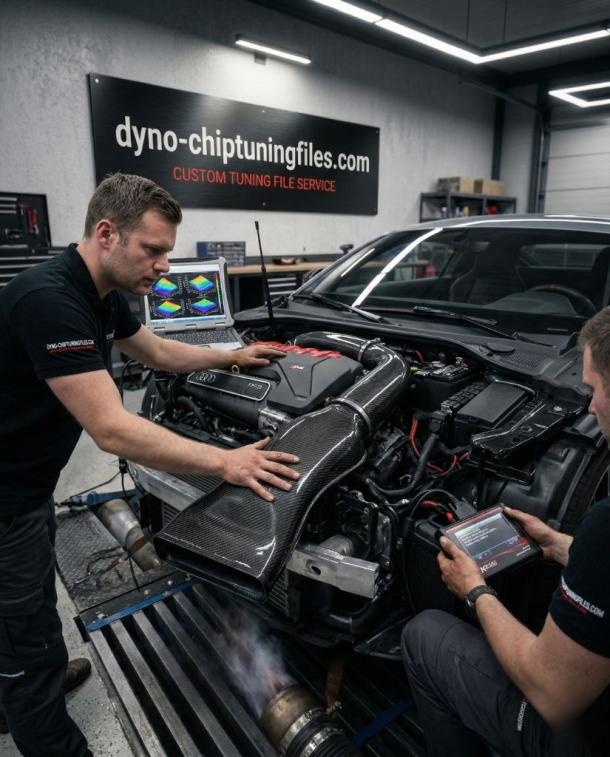
How boost affects engine performance and safety
While the equation "more boost equals more power" is generally true, it is not without its technical complexities. Increasing the boost pressure also increases the heat generated during compression. If the intake air becomes too hot, it can lead to detonation (knock), which is catastrophic for engine internals.
This is why professional calibration from Dyno-ChiptuningFiles is vital. When we develop a tuning file, we do not simply "turn up the boost." We manage the relationship between:
-
Boost levels and ignition timing: As pressure increases, timing must often be retarded to prevent pre-ignition.
-
Fueling requirements: Increased air requires a proportional increase in fuel to maintain a safe air-to-fuel ratio (AFR).
-
Thermal management: We monitor exhaust gas temperatures (EGT) to ensure that the turbocharger and engine components remain within their safe operating windows.
Why professional dyno testing is essential
Every engine has a mechanical limit. A "power boost" that is too aggressive for the stock hardware can lead to head gasket failure or bent connecting rods. At Dyno-ChiptuningFiles, our certified programmers develop all files on 4x4 dynamometers. This allows us to observe how the boost pressure behaves under real-world loads, ensuring the delivery is smooth and the power is sustainable.
For workshops, offering a boost-based tune from a trusted file service means providing a product that has been rigorously tested. It allows you to deliver a "factory-plus" experience where the car feels more responsive and powerful without sacrificing the daily driveability or longevity that customers expect.
As automotive technology continues to advance with variable geometry turbos and electric boosting systems, the expertise required to tune these machines grows. Partnering with a specialist ensures that you stay at the forefront of the industry, delivering maximum performance through precise boost control.