
Ecu programming: a professional guide for tuners
Explore the technical realities of ECU programming. Learn about the tools, processes, and precision required for professional engine calibration.
In this article
Ecu programming, what it is and how it works
In the contemporary automotive landscape, the Engine Control Unit acting as the central nervous system of the vehicle is paramount. For professional tuners and workshop owners, understanding the intricacies of ECU programming is fundamental to unlocking performance, improving fuel efficiency, and ensuring engine longevity. At Dyno-ChiptuningFiles, we view ECU programming not merely as a software update, but as a precise recalibration of the potential within a vehicle.
Understanding the fundamentals of ecu programming
ECU programming, often referred to as remapping or chiptuning, is the process of modifying the software residing within the engine management system of the vehicle. This software, known as a map, dictates how the engine responds to various inputs such as throttle position, ambient temperature, and air density. By adjusting parameters like ignition timing, fuel injection duration, and boost pressure, a programmer can optimize the combustion process for superior output.
Can you reprogram an ecu?
Virtually every modern vehicle equipped with an electronic management system can be reprogrammed. While early systems required the physical replacement of a microchip, modern units use flash memory. This allows for the data to be overwritten via the On Board Diagnostics port or directly through the Bench or Boot mode. However, the success of this process depends entirely on the accessibility of the processor and the security protocols implemented by the manufacturer.
The technical execution: is ecu programming easy?
There is a common misconception that ECU programming is as simple as clicking a button. In reality, it is a highly technical discipline that requires a deep understanding of thermodynamics, mechanical tolerances, and software architecture.
While the physical act of writing a file might seem straightforward, the development of that file is where the expertise lies. A novice mistake in the fueling map or ignition timing can lead to catastrophic engine failure. This is why professional workshops rely on Dyno-ChiptuningFiles. Our certified programmers develop and test every file on a dynamometer to ensure that the increased power remains within the safe operational limits of the hardware.
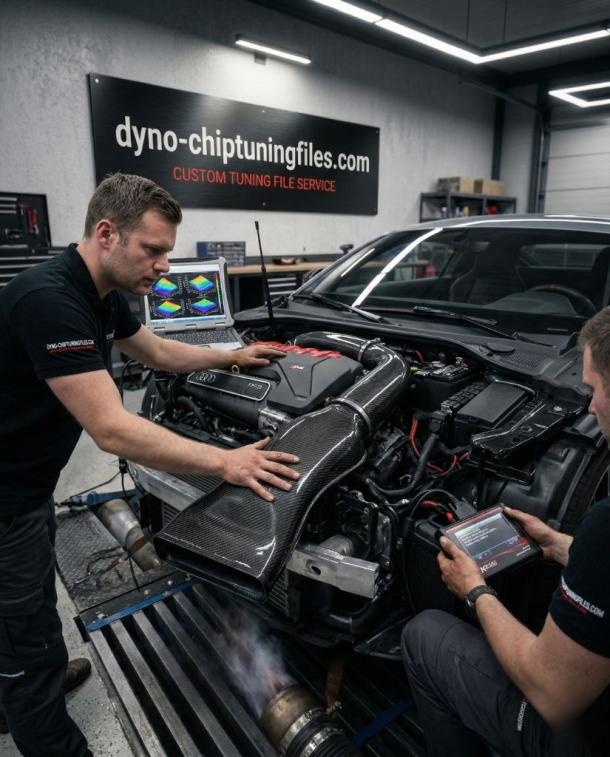
Requirements for professional reprogramming
To reprogram an ECU professionally, a specific set of tools and conditions is required:
-
High quality tuning hardware: Tools such as Alientech KESS3, Autotuner, or bFlash are industry standards for reading and writing data safely.
-
Stable power supply: A constant voltage battery maintainer is critical. If voltage drops during a write sequence, the unit can be rendered unresponsive.
-
Reliable file service: Access to a database of dyno tested chiptuning files is essential for delivering consistent results to customers.
-
Diagnostic equipment: Before any programming begins, a full health check of the vehicle must be performed to ensure no underlying mechanical issues exist.
Tailoring the solution: can you program my car ecu?
A frequent inquiry from workshops concerns the compatibility of specific vehicle models. At Dyno-ChiptuningFiles, our expertise extends across a vast spectrum of vehicles, including passenger cars, light commercials, trucks, and agricultural machinery. Because we utilize custom solutions, we can cater to specific hardware upgrades like larger turbochargers or modified exhaust systems.
When you partner with a professional file service, the question is rarely whether a car can be programmed, but rather how it should be programmed to meet the specific goals of the client while maintaining reliability.
The economics of professional calibration
Understanding the cost structure of ECU programming is vital for workshop profitability and customer transparency. The price to get an ECU programmed or reprogrammed varies based on several factors:
-
Complexity of the unit: Newer high security units require more sophisticated tools and more time to bypass tuning protections.
-
Service level: A generic file is often cheap but carries significant risk. A custom, dyno tested file from Dyno-ChiptuningFiles represents a higher value due to the research and development involved.
-
Hardware requirements: If the unit must be removed from the vehicle for Bench or Boot mode programming, the labor cost will naturally increase compared to a standard OBD flash.
Generally, for a professional workshop, the cost to program an ECU involves the purchase of credits or a flat fee for the modified file, plus the internal labor and overhead for the equipment used. Investing in high quality files ensures that you avoid the hidden costs of engine damage or repetitive troubleshooting.
The value of dyno tested files
Choosing a service like Dyno-ChiptuningFiles means you are investing in precision. Our files are not just modified; they are validated. We measure the real world output and monitor data logs to ensure that every adjustment translates into a tangible and safe performance gain.
For those looking to elevate the capabilities of their workshop, the path forward is clear: rely on technical expertise, use the right tools, and never compromise on the quality of your tuning files.